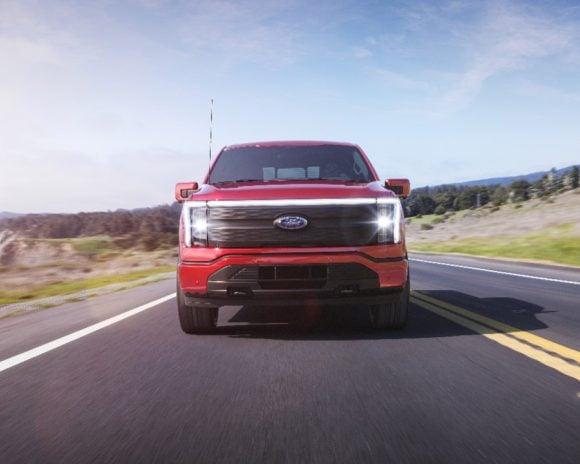
The Ford F-150, king of American pick-ups, aimed to be a pioneer with its electric version, the Lightning. Unfortunately, after a promising start, this flashy model has failed to go the distance. Barely three years after its launch, it is already sidelined, forcing Ford to reevaluate its electric strategy. A sad ending for a vehicle that was supposed to embody the future.
A thunderous start for a lightning-fast journey
Launched with drums and trumpets in 2022, the Ford F-150 Lightning was presented as the future of electric pick-ups. Its name, “Lightning,” which evokes lightning, now seems prophetic. Indeed, this automotive giant is set to disappear from the catalog by the end of the year. A tough blow for Ford, which had bet big on this high-potential electric model. This fiasco highlights the challenges of a still timid ecological transition in the United States. The F-150 Lightning, based on the best-seller in the North American market, had all the cards in hand to establish itself.
A rapid decline for the Ford F-150 Lightning
To impress thrill-seekers, Ford equipped the F-150 Lightning with powerful engines ranging from 452 hp to 580 hp. With such horsepower under the hood, it could sprint like a sprinter in a Formula 1 race while towing heavy loads without breaking a sweat. But alas, despite its impressive batteries (98 kWh, 123 kWh, or 131 kWh), the range never really convinced consumers. On the EPA cycle, considered more rigorous than our WLTP, the range fluctuated between 240 and 320 miles (or between 386 km and 514 km). It’s a bit like wanting to cross the country on a motorcycle: it may seem exciting on paper, but it quickly becomes exhausting if you have to make too many stops.
After a blazing start with over 150,000 pre-orders, sales quickly plummeted, leading to production interruptions worthy of the best television series scenarios. This scenario is reminiscent of the Tesla Cybertruck, which is also behind schedule.
A future generation of Ford F-150 Lightning… inspired by Stellantis?
On its side, rival Stellantis is rubbing its hands together for having canceled its 100% electric pick-up project in favor of a range-extended model. The RAM 1500, initially planned as a direct competitor to the Lightning, has undergone a strategic turnaround. Instead of an electric version, it will ultimately be equipped with a V6 to extend its range. A decision that could prove wise in light of the obstacles faced by Ford.
Alongside this announcement, Ford was quick to unveil its plans for the next generation of the F-150 Lightning. It promises to achieve a staggering range of over 700 miles (or 1,126 km) while maintaining impressive performance: 0 to 60 mph in under five seconds and towing capacity worthy of a freight train. Doug Field, Ford’s electric vehicle director, assures that this future model will be designed to combine versatility and efficiency.
A shift towards hybridization
In the face of these challenges, it would not be surprising if Ford revises its strategy to include more plug-in hybrids in its lineup. This approach would help bridge the gap between internal combustion vehicles and electric ones while reassuring customers who crave power and range. Imagine a pick-up capable of filling up at the pump while recharging at the station like a good old crossover!
Indeed, this hybridization could offer a pragmatic solution for users who need a versatile vehicle for their daily commutes and outdoor getaways. Hybridization could well be the answer to the expectations of Americans, who are often reluctant to completely abandon internal combustion engines.
The challenge of the energy transition
The fall of the F-150 Lightning highlights the difficulties faced by automakers in their quest for more sustainable mobility. The energy transition is a slippery slope where each player tries to juggle between innovation and profitability. Ford is not alone in this race; every brand navigates between electrifying promises and market realities.
Consumers have become more demanding: they want not only eco-friendly vehicles but also ones that can compete with their traditional counterparts in terms of performance and range. If the F-150 Lightning had managed to meet these expectations with aplomb, we might have had a very different story.
In conclusion, the F-150 Lightning presented itself as a fallen hope in the electric conquest of pick-ups. As Ford prepares to turn the page on this chapter, it is clear that the future of the industry will depend on the ability of brands to innovate while considering the real needs of consumers. If it’s not won yet, the story continues…