
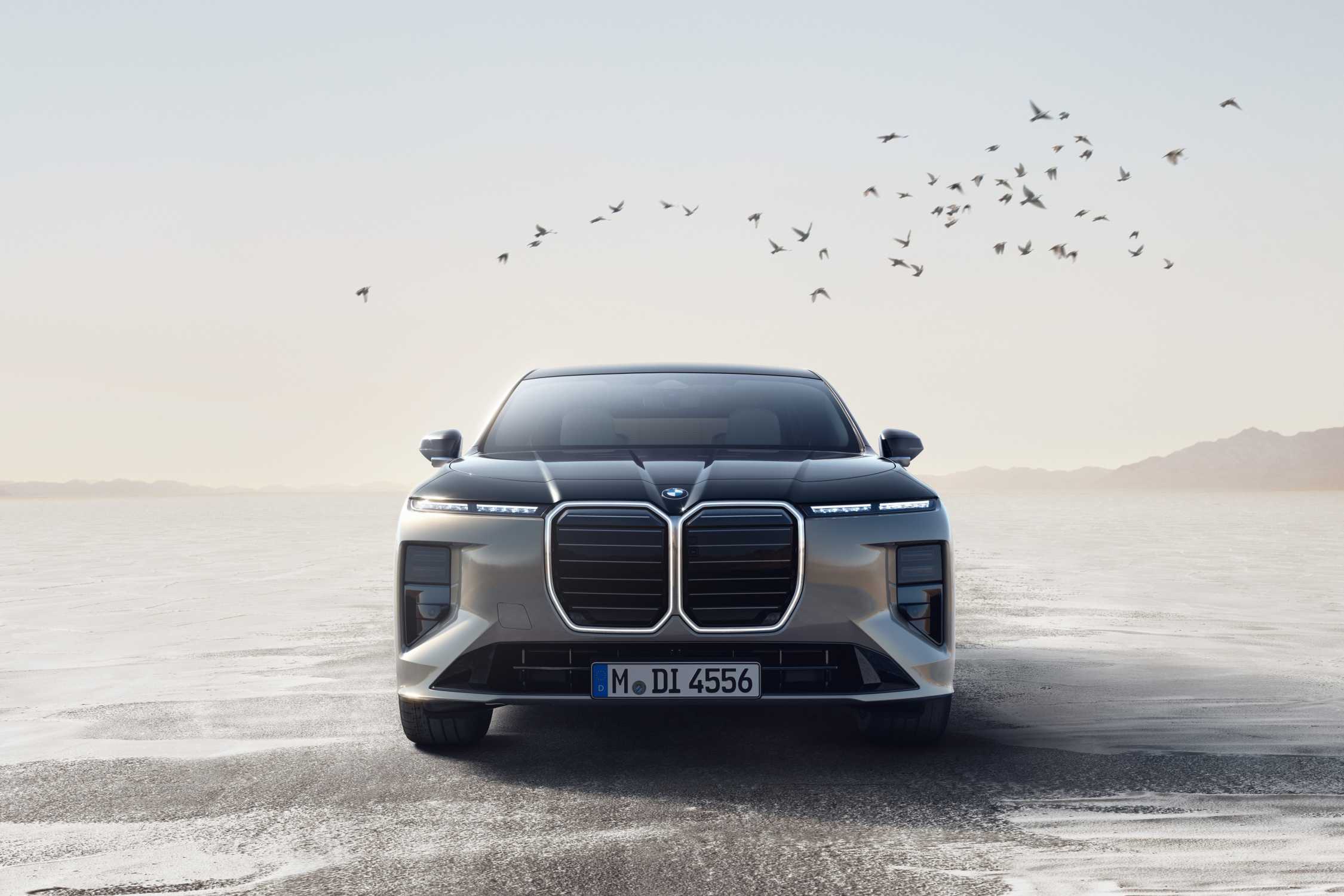
BMW has detailed a substantial update for the 7 Series, and the headline is not styling or trim but the early arrival of Neue Klasse technology in its current flagship saloon. That matters because BMW is using its most expensive model to introduce hardware and software that will later spread across the wider range.
In other words, this is less a routine facelift than a technology transfer exercise. BMW says the revised 7 Series will be revealed on 22 April 2026, with production and global sales due to begin from July 2026.
The real story is BMW’s decision to debut Neue Klasse systems in today’s 7 Series
BMW is presenting the new 7 Series as the first luxury saloon to receive technologies from its forthcoming Neue Klasse programme. That is the key point here. Rather than waiting for an all-new model family, BMW is feeding those systems into its existing flagship first, using the 7 Series as a test bed and a shop window in equal measure.
That approach tells you two things. First, BMW wants to accelerate the rollout of its next-generation tech. Second, it still sees the 7 Series as the car best placed to carry new digital architecture, driver assistance and EV hardware without compromise on cost or packaging.
Design changes are significant, but they serve presence more than reinvention
BMW describes this as the most extensive update yet applied to the 7 Series, and visually the car does move on. The revised saloon gets a more monolithic look, a new illuminated kidney grille, crystal-effect headlamps and a cleaner rear-end treatment. Wheel sizes run from 20 to 22 inches, while M Performance models and the M Sport packages add a more assertive set-up.
Even so, the broader theme is continuity rather than reset. BMW is refining the 7 Series’ presence in the luxury class rather than rewriting it. That makes sense in a segment where visual authority matters, but it also means the bigger shift happens beneath the surface, not in the sheet metal.
The cabin becomes even more screen-led, with rear passengers a clear priority
Inside, BMW is leaning harder into the 7 Series’ dual role as owner-driver car and chauffeured luxury saloon. The headline additions are BMW Panoramic iDrive, a new BMW Passenger Screen and an upgraded Theatre Screen for rear-seat users. BMW also mentions new steering wheels, revised automatic doors, a digital interior mirror and features such as four-zone climate control, a panoramic glass roof and the Travel & Comfort System.
The direction is clear enough: more of the car’s value is now tied to display technology, software and entertainment rather than traditional luxury cues alone. That suits the segment, especially in markets where rear-seat comfort is crucial, but it also means the 7 Series is becoming more dependent on its user interface being genuinely intuitive rather than merely feature-rich.
Electric range is the hard number BMW wants to lead with
BMW will continue to offer the 7 Series with combustion, plug-in hybrid and fully electric powertrains, which keeps the line-up broad by luxury-class standards. The most concrete claim concerns the electric versions, which BMW says now offer more than 720 kilometres, or 447 miles, of WLTP range thanks to cylindrical cells from sixth-generation BMW eDrive.
That figure matters more than many of the softer claims around digital convenience because it speaks directly to usability. For buyers considering an i7, a longer official range eases one of the usual objections to a large electric luxury saloon. The caveat, as ever, is that BMW has not detailed battery capacities, charging performance here or model-by-model outputs in this material, so the practical gap between versions remains unclear.
BMW is widening the line-up, but not every detail is on the table yet
BMW says the updated range will include efficient combustion engines with 48V mild-hybrid technology, plug-in hybrids and electric variants. It also confirms the BMW 740d xDrive will be joined by the BMW 740 xDrive, alongside two plug-in hybrid models and three M Performance variants.
What BMW has not provided in this announcement is the full breakdown of power outputs, battery sizes, charging speeds or market-by-market availability. That leaves an incomplete picture for anyone trying to assess the line-up on engineering substance alone. The strategy is clear, though: give the 7 Series enough drivetrain breadth to cover traditional long-distance buyers, electrified company-car users and performance customers in one family.
Driver assistance moves on, although it remains firmly in Level 2 territory
On assistance systems, BMW is promising a broader standard safety package and a more capable semi-automated suite under the Symbiotic Drive banner. The Motorway Assistant allows hands-off driving at up to 130km/h in many European countries, while the City Assistant adds navigation-guided support for address-to-address urban journeys. BMW also highlights AI-supported parking space detection and manoeuvre planning.
That sounds ambitious, but the important limit is equally clear: this is still SAE Level 2. So while convenience and workload reduction may improve, the legal and practical responsibility remains with the driver. In that sense, the 7 Series is following the luxury-sector pattern of pushing assistance further without crossing into genuine autonomy.
BMW is using the 7 Series to showcase its full luxury brief, from chassis tech to armoured protection
Beyond infotainment and powertrains, BMW is keen to stress that the 7 Series still has to deliver the fundamentals of a flagship saloon. Standard adaptive two-axle air suspension remains central to that, with optional Adaptive Chassis Control, Integral Active Steering and roll stabilisation offered to widen the car’s comfort-versus-agility bandwidth. BMW is also introducing 22-inch wheels from the factory for the first time.
At the top end, the 7 Series Protection continues as the security-focused derivative, with BMW quoting VR9 certification and optional VPAM 10 classification. That is a reminder that the 7 Series is not just a luxury saloon but a global flagship with diplomatic, corporate and security roles to fill. It also explains why BMW is using Dingolfing as the sole production site for every drivetrain and body variant on one line.
What this update actually tells us about the next phase of BMW’s flagship strategy
- BMW is using the 7 Series to introduce Neue Klasse technology before a full model change.
- The biggest changes are digital architecture, assistance systems and EV hardware rather than pure design.
- BMW claims more than 447 miles of WLTP range for electric versions, a key number in this announcement.
- The line-up will continue to span combustion, plug-in hybrid and fully electric models.
- Some important technical details, including outputs and charging data, have not yet been disclosed.
- World premiere is set for 22 April 2026, with production and market launch from July 2026.
What BMW has unveiled, then, is a 7 Series update that matters chiefly as a signpost for the brand’s next-generation technology plan. For luxury buyers, the appeal will depend on priorities: rear-seat tech, long-range electric running, traditional six-cylinder usability or top-end security provision. Obvious rivals remain the Mercedes-Benz S-Class and EQS, while at the upper end of the electric market the Lucid Air is the range benchmark BMW is plainly aiming to answer.


